Erikson’s eyes settled on Ralph’s lapel. The American flag pin was not just any American flag lapel pin. It was a custom design that Erikson had seen before. “You’re right, Mr. President. I am running for President because you insist on fighting the Western States of America.” He knew who had worn that pin before its current bearer. “But there is something else that needs to be clarified, and that is the reason why you insist on fighting the sovereign and independent Western States of America. For me, this election is about California, yes, but for you, California is about Mark Adams.”
Ralph turned dead pale.
“I don’t know why, considering you only really met the man the day of the attack on San Francisco. I only know what I saw at that last Cabinet meeting, when we took the vote. When you raised your hand to vote with him, you looked as you do now. You voted with him against your better judgment because you thought it was your duty. You continue to fight the WSA because you think it is your duty to continue Adams’s delusional policy. But it is time that you get over his death and accept reality.”
Quietly, weakly, Ralph plead, “Mr. Erikson.”
“At that meeting, your would-be Vice President Paul Navarro voted to let go of the West.”
A little firmer, Ralph tried again, “Mr. Erikson.”
“At that meeting, your own wife voted to let go of the West.”
“Erikson!” Ralph screamed with the sum of his rage and hatred.
Finally, Erikson stopped talking and stared at his pathetic prey with a cruel and sadistic smile.
“Erikson,” Ralph was hoarse. He glared at the man with all his might. He spoke as firmly as he could, “This is not about Mark Adams.”
“Of course it is. What happened to your straight talk? What happened to your so-called honesty, Mr. President? What happened to doing the quote-on quote,” he could not resist the urge to make demeaning little air quotes with his fingers “right thing no matter what? Face it,” he sneered, “this is about Mark Adams.”
“Shut the hell up!” Ralph gasped in exasperation. Erikson was killing him—in public, and on his birthday, for God’s sake. “I’ve continued Adams’s policies because Mark Adams was right. I’ve continued his policies because I know them to be right.” Suddenly, as he spoke and believed himself, he regained the strength that he had lost when Erikson breached the subject of Mark. Ralph found the strength for buoyancy. “We cannot simply let our country fall apart. We have not wronged California, Oregon, Washington, or Nevada in any way. They have no reason to leave this sacred Union, and by God, I cannot let them do it. That is not because of any sense of duty I may or may not feel towards the memory of Mark Adams; no, indeed, it is because of what I learned from Mark Adams in the three days between the secession and his death. He taught me that you don’t give up on something just because it seems like a lost cause. You fight harder. Erikson, I am more myself now than I have ever been. This is straight talk, and this is honest truth. Fighting for our Union in the face of your foolish adversity is the right thing to do. And that is why I have fought for a seemingly lost cause these past nineteen months. That is why I intend to continue fighting for a seemingly lost cause. I’ve done and will continue to do it because I don’t care that it is a seemingly lost cause. Our Union cannot be lost, and I will fight for it and lose if I must.” He stopped for air. He surveyed the auditorium full of blank, shocked faces. Bob Schlesinger looked like he really might have that heart attack now. Erikson, again, was shocked into silence.
He stood up slowly, breathing heavily. He did not smile, did not even try. He turned to walk off stage, but he caught another glimpse of Erikson’s face. He turned back. “By the way,” he snickered, “if you wanted to run against Mark Adams, you should have run for President four years ago.”
"We are what we pretend to be, so we must be careful about what we pretend to be." Kurt Vonnegut. I now pretend to be an author. Let's see how it goes.
31 December 2008
Progress Update: Lost Causes
30 December 2008
Progress Update: The Silent Scream
Finally, at almost 3:30 am, I can say that I have finished Chapter 3. It has just about killed me, considering I wrote it without much of a plan. It is about the conventions, which means that it required both research and coordination. There is very little back-and-forth dialogue, which is probably why it took six hours to write.There are, however, two 850+ word speeches. Those are damn near impossible to write. Anyhow, overall, this chapter is 4600 words and 14 full pages. I feel a need to sleep now.Now it was Thursday, or Day Four of convention Hell, and it was his turn to make a few ill-received jokes. He was supposed to be getting ready, but he didn’t much feel like getting ready. Thus he sat in the rickety director-style chair in an undershirt and Johns Hopkins sweats, staring at his reflection in a well-lit mirror while the television humming in the background. He considered his reflection. He looked relatively good for a wartime President running for reelection with dismal approval ratings. He got four and a half hours of sleep, on average, and to be sure, there were bluish circles under his eyes. But they didn’t look as dark or deep as he would have thought. He was a little pale, but not alarmingly so. He still had some sense of youth about him. His fortieth birthday was in exactly two weeks, now that he thought about it. Everything seemed to be in order in this visual inventory—everything except his eyes. They were as black as always, and they sparkled a little in the blinding incandescence. Physically, they were fine. The problem lay in what he saw behind them. The pain and torment that he felt constantly burned brilliantly in the reflection. He saw the silhouette of his soul silently screaming like the famous Edvard Munch painting. Knowing the pain was there and feeling it was wholly different from seeing yourself tormented by it. In the depths of his eyes, he did not look healthy. He did not look like he got any sleep at all. He looked paler than the Grim Reaper and older than the country. And he knew, looking into his eyes, that the truth lay here, and not in the rest of his reflection. He was not healthy, not in the least. He was just Dorian Gray, putting up a youthful, cheerful façade for everyone in the world, even his wife. On the inside, he was just as haggard as Mark’s corpse was sure to be.
He forced his face into his hands and massaged it vigorously. He rubbed his eyelids with a passion, praying that he could rub away the truth he had just seen. It could not help him to keep the memory on the surface of his consciousness; nay, it could only detonate his self-destruct sequence a little sooner. And who could that possibly help? Not him. Not Jane. Not the country. Not Mark. No one.
29 December 2008
Progress Update: Handkerchiefs and Hardships
Well, again, I am still behind where I should be, though I seem to be making up ground rather respectably. I feel good--like I have accomplished quite a bit more in one day than I have in a long while. Chapter 2 has 4500 words and 15 full pages. I am doing well on consistency this book, I think. Again, I must go write another 4000+ word chapter. Here is an excerpt of what happens when Ralph asks Jane what she really thinks of the neo-War Between the States.She sat up. “Ralph, I understand your side of it. I do. I understand that you need to defeat the Western States of America because that’s what he would have done. I understand that you can’t bear the thought of letting a third of the country slip away on your watch because you think that that will mean you failed to do your duty—by the country and him. I understand that you feel you need to fight his battles now that he’s gone. I understand that, I really do, Ralph.” Her eyes shined in the darkness. “But Ralph, what about your other duties? You have a duty to the preserve the Constitution, which you can’t do while the Nationalist Act is in effect. You have a duty to the people—not to mislead them, not to strangle them, not to have soldiers killed in a losing battle while we are losing another battle an ocean away that we cannot afford to lose. I understand what you’re doing, Ralph, but” she seemed to calculate whether she should say what she was about to say or let it wait until she could see through his eyes to his soul, “it isn’t what I would do.”
If she had been able to see through the darkness, through his eyes, to his soul, she would have known that her words were killing a part of him. His soul screamed silently while he stared on blankly. He had no response to what she had just said. He had expected it, or at least, he should have expected it. But hearing his wife—his wife—as good as say that she would leave the rebels alone and free to establish there own government and do all things which free nations ought to do—it hurt more than the daily pain of missing Mark. He was truly alone in the universe, with the exception of a construct of his imagination and its real-life daughter. He was sinking again, drowning in the depths of his pain.
Progress Update: The Last Honest Man in Washington
This is going rather slowly. I just finished Chapter 1, significantly later than expected. Oh well. I have faith in my ability to recover. It is rather longer than expected: 16 pages and 4600 words. Not too shabby. Ralph's new campaign slogan is "The Last Honest Man in Washington" and Erikson's is "Change We Can Trust". And yes, Erikson's is indeed a gramatically correct hommage to Barack Obama. I really can't say much more if I want to write another chapter and a quarter today. But here is a brief excerpt, anyways.He reflected tersely upon his lost life and forced himself to spin faster. The objects of his contemplation blurred beyond recognition, along with his pained reminiscences. He lowered his gaze to his feet and watched his scuffed black shoes spin in rhythm with the world. He felt the sum of his doubts well up in his throat and wondered if he was going to be sick. He shut his eyes and willed the speed to increase. The inertia carried he and his along. He missed him so much. He kept trying to forget, but he couldn’t. Whenever the CIA briefed him or a military official tried to explain it to him or Erikson made some vicious attack on national television or a dove—or even, for God’s sake, a pigeon—flew past his window, he remembered who he used to be and what he was now. He used to be the Baltimore District Attorney. He used to be successful and popular. He used to have morals. He used to do his duty, and never second-guess it. He used to know, with every fiber of his being, that he was doing right. He used to be an optimist, and happy all the time. But now… Now, sure, he was the President of the United States, but he still felt as powerless as he had as Vice President. Now, he was a failure and had approval ratings in the mid 20s. Now, he had lost all his once precious morals. Now, he did his duty—did it better than ever before—but second-guessed every single move he made. Now, he knew, with every fiber of his being, that he was not doing right. Now, he was closer to a nihilist than anything else, and truly happy around only one person, moderately happy around two, and thoroughly miserable around everyone else and by himself. So what about now? Now, life was a veritable Hell.
He knew that he should think that all of this was because of Mark. He knew he should realize that Mark had destroyed his life by asking him to replace Davidson. He should have known then, a year and a half ago, that nothing but trouble could come from being the second most powerful man in the world, and he should have said no. In fact, he did try to say no, at first. But Secretary Navarro, acting as Mark’s nonexistent Chief of Staff, had said it was President Adams’s personal wish that he take the offer; Navarro had told him that it was his duty to his country to take the offer. Ralph had caved; he should have insisted that he could not do it. It wasn’t Mark’s fault. It was his. He had accepted the damned job. He had let Mark warp him into his own personal yes-man. He had made the conscious decision to carry on Mark’s wars and policies after his death. He was wholly responsible for his own unhappiness.
28 December 2008
Before the Ball Drops
It would seem to me that it is almost 2009. When it was almost 2008, I publicly pledged to write two new chapters for the first book. When it was almost 2007, I pledged, not publicly, to finish part one of the then only book. It seems fitting, thus, that I should set myself another wholly impractical goal, seeing as the aforementioned were both accomplished.Therefore, I hereby solemnly swear that I shall finish Part I of my second book, The Calmness of Martyrs, by 6:00 am on the First of January 2009. (Last year I finished around 4 am, if I do recall.) If I am to accomplish this goal, I have quite a bit of work to do. I must finish chapters 1 and 2 today, I suppose, and then write one chapter a day. That is a rather brisker pace than I am used to, considering I have done so little with this book.
It is my intention to entitle Part I Cosmos and Part II Chaos. I think Carl Sagan would be pleased. I would quote him at the beginning of the section; however, I quote Sagan much too much. Thus I will quote Will Durant: "Civilization begins with order, grows with liberty, and dies with chaos."
But I should really get to writing if I want to accomplish my goal for the third year in a row. Good luck, self.
27 December 2008
The Fine Frenzy of My Feverish Mind
For the past 364 days or so, I have fallen asleep to the songs of Alison Sudol, or A Fine Frenzy, as she calls herself. I am a fan of the entire album; however, two songs always stood out. They always seemed relevant to my novel universe. I thought perhaps that they partially expressed Ralph's sentiments following Mark's death.
The first song is perhaps the most well-known on the CD, "Almost Lover". There is a certain profound sadness to it that is seldom heard in music. It never quite felt perfect, considering Ralph is not a homosexual. But something felt right. A few days ago, I listened to this song and realized that I had been wrong. It wasn't relevant because of Ralph; it was relevant because of me. I am the one who loves him, who killed and lost him. The chorus:
Goodbye, my almost lover
Goodbye, my hopeless dream
I'm trying not to think about you
Can't you just let me be?
So long, my luckless romance
My back is turned on you
Should've known you'd bring me heartache
Almost lovers always do
It fits so goddamn well. He is just my hopeless dream. I try not to think about him, considering I killed him and all, but he won't leave me alone. I created my dream man, and by God, I keep thinking of Pygmalion. I should have known that this would happen, and I should have avoided it.
The second song is entitled "Near to You". It always seemed to work better from Ralph's perspective, in terms of Jane and Mark. There were still the gender issues, but whatever. After I had my realization about the first song, though, I rethought this one. I listened to it, and immediately it fit. The first stanza clearly seemed to describe my feelings about Mark.
Goodbye, my hopeless dream
I'm trying not to think about you
Can't you just let me be?
So long, my luckless romance
My back is turned on you
Should've known you'd bring me heartache
Almost lovers always do
It fits so goddamn well. He is just my hopeless dream. I try not to think about him, considering I killed him and all, but he won't leave me alone. I created my dream man, and by God, I keep thinking of Pygmalion. I should have known that this would happen, and I should have avoided it.
The second song is entitled "Near to You". It always seemed to work better from Ralph's perspective, in terms of Jane and Mark. There were still the gender issues, but whatever. After I had my realization about the first song, though, I rethought this one. I listened to it, and immediately it fit. The first stanza clearly seemed to describe my feelings about Mark.
He and I had something beautiful
But so dysfunctional, it couldn't last
I loved him so but I let him go
'Cause I knew he'd never love me back
Then it goes on. The rest of the song deals with the speaker's feelings toward her audience. I assume that my audience is Ralph. I know that he is so much better for me to write about. He's just better. And while it hurts like hell, I'm getting over the obstacles I wrote for myself. It's getting easier. Or isn't that what I told myself 13 months ago?
But so dysfunctional, it couldn't last
I loved him so but I let him go
'Cause I knew he'd never love me back
Then it goes on. The rest of the song deals with the speaker's feelings toward her audience. I assume that my audience is Ralph. I know that he is so much better for me to write about. He's just better. And while it hurts like hell, I'm getting over the obstacles I wrote for myself. It's getting easier. Or isn't that what I told myself 13 months ago?
Such pain as this
Shouldn't have to be experienced
I'm still reeling from the loss,
Still a little bit delirious
Near to you, I am healing
But it's taking so long
'Cause though he's gone
And you are wonderful
It's hard to move on
Yet, I'm better near to you.
Shouldn't have to be experienced
I'm still reeling from the loss,
Still a little bit delirious
Near to you, I am healing
But it's taking so long
'Cause though he's gone
And you are wonderful
It's hard to move on
Yet, I'm better near to you.
01 December 2008
Bravery and Beauty
I am now going to be incredibly pretentious and compliment myself. I have shown a high form of literary bravery in the past few weeks, I think. To be sure, I post excerpts of my writing on this blog, but no one reads this blog, and they are but excerpts. Now, I have begun to spoon feed my entire first novel to a real live human being. I gave it to him out of guilt, I think, seeing as he was the only one of my friends who, after having known me for two years, still did not know that I had written a novel. That and the fact that he pestered me incessantly for a week. Oh, I should be made of sterner stuff.
He has read the prologue and entire first part; he currently has in his possession the first two chapters of part two. He says he likes it, that it is good, and that he doesn't mind Mark's being completely bipolar. I doubt he will maintain any of these once he finishes the book.
Yet all the same, despite my childish insecurities, it was a step. Every time I hand him a neatly stapled stack of crisp white novel the adrenaline pounds against my veins, and I feel so alive. It isn't about giving my writing to someone else--it's about holding it in my hand. Seeing the chunks of manuscript--of thought transmitted onto hundreds of sheets of paper, stacked and stapled, and knowing that those words are yours--my God, it is the most numinous feeling. I can only imagine what it must feel like to hold the first copy of a published book...
Note: The novel in the picture is not my novel. Mine is considerably shorter, yet beautiful all the same.
18 September 2008
All Bound Up
Yesterday was Constitution Day. Not that that is terribly relevant.
Perhaps the most important thing to record is that I have finally bound Ralph and Jane; they are all bound up in marriage. Their wedding was on the Fourth of July, and they are spending their honeymoon in Paris.
I finally got around to explaining why Ralph loves her. It is actually quite fascinating and somewhat unexpected a rationale, even for me as the author.
For a moment, as the sun sank in this dazzling radiant fashion, he felt what she felt. He felt the sheer joy of living and loving—the mere radiance of being. The goodness that he had smelled in her at the funeral over a year ago now intoxicated the air. He breathed it in deeply, urging it to invigorate his cells with passion. He wanted to live life as a brilliantly glowing meteor, as Jane did, and not as a cold, dead planet. He wanted her freedom of being. She was unbound by the supposed law of gravity; she had the ability to simply fly away into the glorious blaze. Her spirit could detach itself from her body, and she could ascend to the heavens. She felt life with every atom of her being, lived as if they were burning with joy, and she felt so much! She felt the usual array of emotions, yes, but she felt so much more than that. She felt the last remnants of the day’s exhilaration pan out over them in the watercolor of the sky. She felt the city alive with motion. She felt the air pressing down upon their backs and shrugged it away. She carried no burdens or duties but those to life itself; that was her only duty—to live and to love. And thus she simply lived and loved.That's really all there is to say.
That was what he loved in her. All the things that he was not she was. He tended to be unhappy, but she was always bursting with happiness. He tended to think about the dead, but she never stopped thinking about the living. He was earthbound by duties, obligations, and oaths, but she just flew away when she so chose. He tended to doubt that outside his basic moral convictions, but she always knew everything immediately. He tended to do everything impersonally, but she injected her whole self into anything and everything she did or saw or experienced. In this manner she had injected herself into him. She overflowed the casing of her small body and filled in the cracks in his. She was so complete, he so incomplete that they between them averaged out into near perfection. She made him infinitely better, lifted him out of the metaphorical mud and pulled him to his feet. What he did to her and what she saw in him he really did not know. He figured that while she pulled him up he must be pulling her down—but then again, the laws of physics and motion did not apply to her.
12 September 2008
Fighting the Good War for Liberty
So today--I mean yesterday--felt like a good day to do other hard things, like write Ralph's eulogy for Mark. The beginning and end are too similar to the Gettysburg Address, thus I will quote only the slightly original middle:
“When the assassin held the gun to his temple four days ago, President Adams straightened up and looked at me with the most profound sort of courage. He said, simply in steady voice, ‘Now I become another American martyr; do no let me be the last.’ See, he was always prepared to do whatever was necessary for this great nation, whatever the cost. When he was just eighteen, he swore an oath before the Statue of Liberty to give his life to America—an oath that he fulfilled in full. This might seem foolish to some of you listening—to promise your life away to a flawed, bureaucratic system. So how can we call it laudable for one to damn himself so?
“Because despite its many imperfection, America represents the best in us. She is liberty and truth and justice in the purest forms. And while she may not always carry out these noble goals perfectly, she always tries. That is what matters, and that is what makes her the “city upon a hill” that John Winthrop promised. As Socrates said, ‘The nearest way to glory is to strive to be what you wish to be thought to be.’ The glory is not merely in the outcome but in the intention. Thus, it does not matter if we fight a battle for our ideals and lose; it is the good war we fight in knowing we will lose that matters.
“This is what I learned from Mark in those seven infernal days, and that is what I hope America learns from his death..."
I think that is truly what I learned from creating and murdering Mark Thomas Adams as I did--that it is nobler to fight for an ideal and lose than not to fight at all. That was where I got the title for the first book, coincidentally, The Fallen Caryatid. She is the one who fights a losing battle simply because she must fight it. She knows she will be crushed, but for her own sake, she must fight it. She cannot shrug, for doing so would mean killing all that strives to be right in the world. And so she fights the Good War, even if she must do it alone, doomed to failure. It is the highest form of courage.
Maybe I misjudged the War on Terror in the past. I used to say it was silly to fight against Terrorism because you can never defeat an ideal, which is true but irrelevant, it now seems. I see flashing that we never really fight against anything--we fight for something. Always. Only the glass-half-empty-pessimists see it that way. But as an idealist, I should see it as fighting for something. Always. We are fighting for liberty; we are fighting to prove that Evil cannot defeat Good. It really is, as I called it in my in-depth study a few months ago, a "Good War on Terror". At this moment, at this hour, it doesn't seem that different from any other war. It feels the same. It feels just as real, tangible, and worth fighting as the Revolution, the Civil War, and World War II.
And I am fighting it, I know that. I am fighting it with these glorious words that no one but myself ever reads. I just wish America would undress herself to see the truth as I see it at this moment. The beautifully naked truth is, as John Stuart Mill wrote:
Maybe I misjudged the War on Terror in the past. I used to say it was silly to fight against Terrorism because you can never defeat an ideal, which is true but irrelevant, it now seems. I see flashing that we never really fight against anything--we fight for something. Always. Only the glass-half-empty-pessimists see it that way. But as an idealist, I should see it as fighting for something. Always. We are fighting for liberty; we are fighting to prove that Evil cannot defeat Good. It really is, as I called it in my in-depth study a few months ago, a "Good War on Terror". At this moment, at this hour, it doesn't seem that different from any other war. It feels the same. It feels just as real, tangible, and worth fighting as the Revolution, the Civil War, and World War II.
And I am fighting it, I know that. I am fighting it with these glorious words that no one but myself ever reads. I just wish America would undress herself to see the truth as I see it at this moment. The beautifully naked truth is, as John Stuart Mill wrote:
War is an ugly thing, but not the ugliest of things. The decayed and degraded state of moral and patriotic feeling which thinks that nothing is worth war is much worse.
I only wish America could know herself again--could know this truth so pure, so simple. So forgotten. Thus, let us never forget. On this surreal day after, let us swear to remember that liberty is always worth fighting for. Always.
02 September 2008
Moving On
The face looked so perfect—so clear and lucid. His skin seemed to belong to the Harvard law student he had once been, not the President. It glowed vaguely with the simple brilliance of living, real living. His eyes sparkled as they hadn’t sparkled so marvelously that it thrust a stake in Ralph’s heart. Mark hadn’t looked like that in the last week of his life, he knew; the burdens of the wartime Presidency had sagged his face and dulled his eyes. Ralph knew the same was happening to him now, too. But Mark’s face was the most beautiful, idyllic image, possible only in death and in his own head. Oddly, it wasn’t the thought of being crazy and grief-stricken into delusions that frightened him so but that knowing that would mean accepting that Mark wasn’t there.Death is deliverance. It is peace. It is relief. It is a great, gasping shrug just as one thinks his burdens will crush him. I feel a little less guilty about killing Mark off when I think of him so light and free and true. Speaking of true, Dead Mark says things Live Mark would never say. He is so much more candid and open to feeling irrelevant feelings.
“Why did you pick me for Vice President?”That's what I keep thinking: if I write a little more of this, hold on a little tighter, I will be able to move on sooner. I will be able to stop writing about a Mark who speaks and thinks. I will be able to get past his story and tell Ralph's. I will stop thinking he means so much to me. I will write as any good writer should--with an element of detachment. But by God! I can't help answering as Ralph does after the last passage:
“Ralph.”
He shook his head. “I had even less experience in government than Benny Dove, and I had never really demonstrated anything like leadership. All I had ever done was get too scared to go to med school the day after I got in. No one even knew who I was, outside of those who were so unlucky as to have me as the Baltimore DA. No one even thought I would run for any political office, let alone be elected.” And then Ralph’s expression changed, not to regret but to a profound sadness that he knew could not, or perhaps should not, be erased. “No one ever believed me corruptible,” his truthful eyes shimmered as they looked dejectedly at the desk, “and now here I am corrupted.”
“Stop it Ralph.”
Ralph met his eyes.
“Do you want to know why I picked you, Ralph? I’ll tell you, but first realize that everything you just said is false as water. Unlike Benny Dove, you worked your entire adult life in a real job. You led Baltimore’s crusade against common criminals. You served your country quite valiantly as a lawyer and saved countless lives—more than any doctor. You created a national reputation for yourself of placing law, justice, and morality above trifles; duty came before personal fancy. You could have won most any Maryland election, including Governor or Senator. Do you want to know why I picked you, Ralph? Because, for God’s sake, you got one thing right: you are incorruptible.” Mark had only paused for air, but the pain in Ralph’s face touched him; it was contorted with surety in wrong and the most torrid sort of guilt. He had wanted to flay it away—watch the doubt and sadness fall off in strips—but he seemed only to have made the wounds raw. He softened his tone, “You have not been corrupted, Ralph. The fact that we are having this conversation shows that you cannot be corrupted. You, Ralph, were always the best of us—better than Erikson, Davidson, or me. I was so dogmatic as to, at times, do foolish things for my ideals; I wanted too much to mold the world into my idyllic childhood vision of how it should be. You are practical and seek to make the world better in ways that are possible and don’t essay to raise the earth to the sky. That is why you and your type will win, in the end. The moral pragmatists and realists will beat out the idealists on both sides of the spectrum—libertarian and totalitarian, capitalist and communist. You will be the ones to save the earth from the fall that seems so inevitable. Oh, if anyone can, Ralph,” the smile faded from Mark’s pale visage, “you will be the one to save her.”
Ralph’s spine wriggled like a worm gripped in a bird’s claws. He shook his head and shut his eyes, “Then she won’t be saved, sir.”
Mark’s smile returned in part, “Have a little faith, Ralph; you are so much better than you know. Never think that you have been corrupted because, by God, you haven’t and won’t be. Just remember that, and you will be able to get along without me.”
“What if I don’t want to?” he queried with crumpled face.
22 June 2008
A Baptism of Fire and Death
She looked out into the gaping void of universe again, and her mind fell into the familiar rhythm of those late nights and early mornings she had spent staring through the window of her soul. She heard the same question she had heard so many times before--the eternal, constant question that she had never had the nerve to answer. "What in this 'empty' universe is worth living for?" her conscience queried. Before she had toyed with pretty responses like knowledge and science, but now she knew. Finally, because the frail finger of fragility had tapped her shoulder, she could answer. "The mere joy of living," she intoned with resolve. Without another moment of hesitation, she kissed Raymond with the fieriest passion known to the human race--the desire to live, to truly live.
"Yes," she answered, "a good day."
It feels so wonderfully sublime to write of such a tragic event that is so positively uplifting and invigorating without being comic and morbid.
18 June 2008
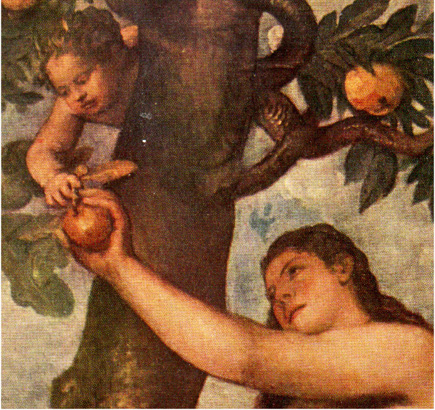
Eve's Song
Ignorance is bliss,
The songbirds chirped;
And in blind bliss she lived
Until one day a green gleam stole her gaze
And she cried, Oh, I want to know.
For knowledge what will you give?
The snake slithered down;
And in timid naivety she approached
Eying the shimmering, forbidden orb
And she cried, Oh, I want to know.
You and your posterity shall know Death!
The Lord roared from above;
And her teeth pierced the tender flesh
As God's wrath rained down upon her
And she cried, Oh, I want to know.
Woman, you have ruined us,
Adam screamed to her;
And she descended Eden with a knowing smile
Seeing the many orchards of sweet fruit below
And she cried, Oh, I want to know.
And know I shall,
She solemnly pledged to herself;
And beginning the most sacred of quests
She freed another apple from the nearest tree
And she cried, Oh, I want to know.
An Apple in the Pie
I have become more of a short story writer and a poet than a novelist of late. I have been working on a collection of works that will, I think, someday appear in a book entitled An Apple in the Pie: A Study in Purpose. The work will be comprised of many of my older poems, the new ones, the final chapter of my beloved book, three short stories, and a few autobiographical narratives and personal essays. All of these explore, to some extent, the purpose of life at both the grand and microscopic scales--why we exist but also why we take certain actions. In the end, I suppose the conclusion is that the purpose is different for each of us, and that--but I'll let you draw your own conclusions.An Apple in the Pie
Wander the graveyard of those souls who have learned to die
Whose forgotten carcasses have long since become ash:
Oh, it's just another apple in the pie.
There is the steelworker's song of when all goes awry
And life ends with a cacophony of clangs and a clash:
Wander the graveyard of those souls who have learned to die,
There is the tragedy of the war veteran's unheard cry
As he swallows too many pills from the hospital stash:
Oh, it's just another apple in the pie.
There is the Christian martyr's sorrowful goodbye
As she launches a bomb on a shopping cart with a dash:
Wander the graveyard of those souls who have learned to die,
There is the obsessive-compulsive divorcée's ceaseless caw of why
Since her husband left their life together with the rotting macaroni in the trash:
Oh, it's just another apple in the pie.
Pray to Providence that their sorry souls have ascended to the sky,
Store their stories in some overflowing memory cache,
Wander the graveyard of those souls who have learned to die:
Oh, it's just another apple in the pie.
01 January 2008
Book Stats: The Long & Winding Path
Pages: 220. Words: 65,875. Chapters: 13. Prologue? Yes, I thoroughly enjoy plagiarizing my own first lines. Epilogue? Yes, I have decided it might be my favorite section. Favorite Passage: Still the part where Ralph looks at the stars.
Did I make good? I suppose that is subjective. It is considerably larger now, and it has a prologue. But only one new chapter. Yet I am hardly upset. According to my clock, it is 4:15 AM on Tuesday, 1 January 2008. I am not tired, though I just now finished the prologue. It seems ironic to me that it should be the last thing I write... Oh well, I shall diagram again. (* denotes a chapter started after 24 February 2007):
Part One: This Earthly World
I. San Francisco
II. The Sieve
III. Color
IV. The Kitchen Cabinet*
V. Hong Kong
VI. Catalyst
Part Two: The Lost Frontier
VII. Secession
VIII. Dualism
IX. Scraps of Paper*
X. The Trinity
XI. Sandbox*
XII. The Loneliest Job
XIII. The Roundness of History
Subscribe to:
Posts (Atom)